
A Word Can Be Accurate and Still Be Manipulative
Accuracy is not the final test of a prophetic word. Learn to discern prophetic voices through Scripture, truth, motive, and whether the speaker seeks control.
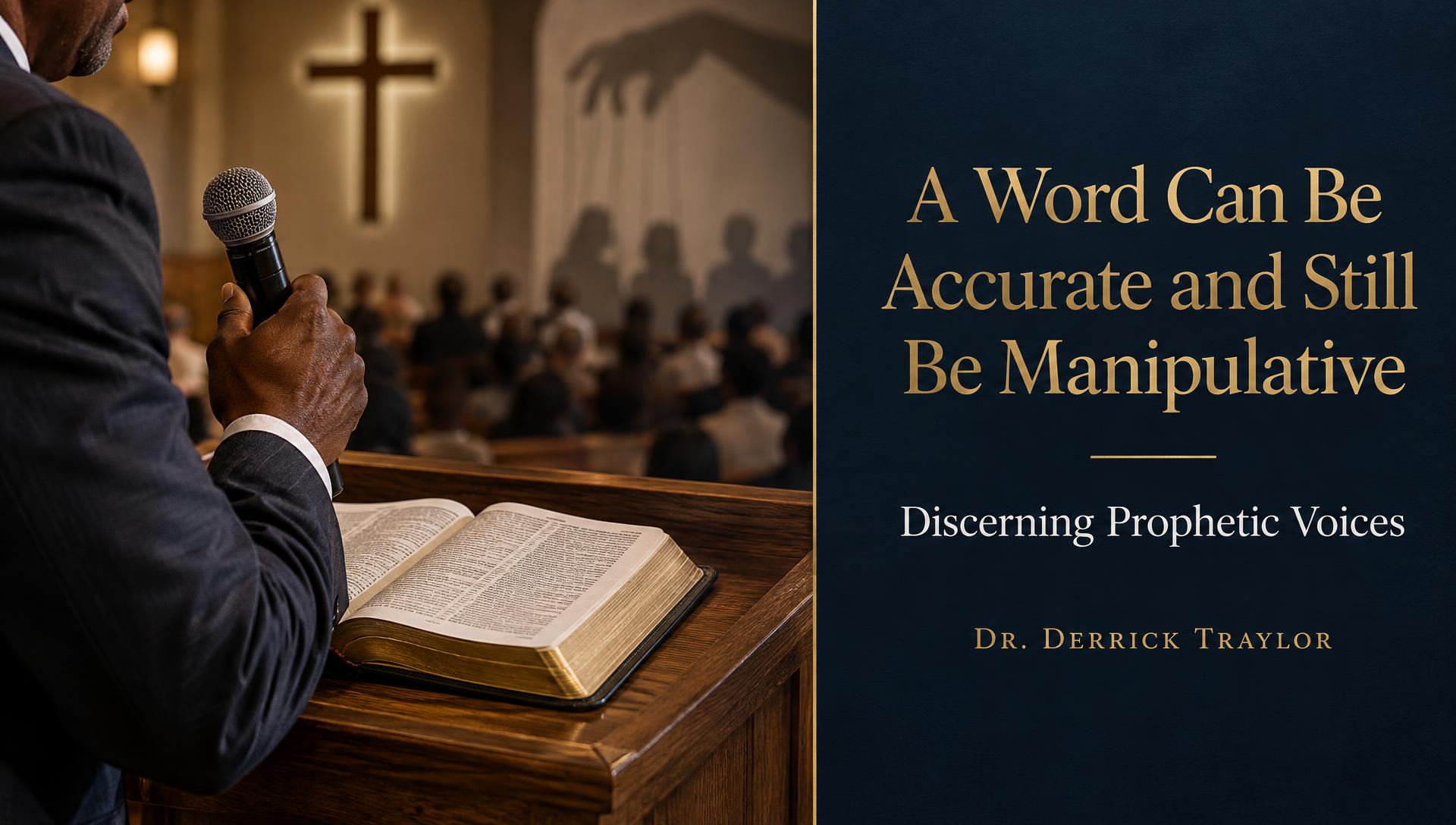
Some of the most dangerous words you will ever hear will be accurate.
They will name the city you are thinking of moving to. They will describe the struggle you have told no one about. They will mention the date, the diagnosis, the relationship, or the decision you have been carrying in prayer. And because the details are right, everything in you will want to say, "That has to be God."
But accuracy is not the final test of a prophetic word. A word can be accurate and still be manipulative.
That is one of the most important truths a believer can learn about prophetic ministry. If we judge a word only by whether the facts were correct, we leave ourselves open to voices that know how to impress us but have no intention of submitting us to God. Scripture calls us to something deeper: to discern the Word, the spirit, the motive, and the fruit behind what is spoken.
1. Accuracy Alone Does Not Prove a Word Is From God
In Acts 16, Paul and Silas were followed for many days by a young woman who cried out, "These men are the servants of the most high God, which shew unto us the way of salvation" (Acts 16:17).
Everything she said was true. They were servants of the Most High God. They were showing the way of salvation. Yet the Bible says she was possessed with "a spirit of divination" (Acts 16:16), and her masters were profiting from her soothsaying. Paul was grieved, turned, and cast the spirit out.
Paul did not judge her by her accuracy. He judged her by the spirit operating through her.
This is the thin line between true prophetic ministry and divination. Both can produce information. Both can be specific. Both can be startlingly correct. The difference is not merely what is said, but what is governing the one who says it—and what the word is designed to do in the one who hears it.
Moses warned Israel about the same reality. Even if a sign or wonder comes to pass, if the speaker uses it to lead you after other gods, "thou shalt not hearken unto the words of that prophet" (Deuteronomy 13:1–3). God sometimes allows accurate words to test whether we love Him more than we love the experience of being told things.
2. The Gift and the Vessel Are Not the Same Thing
A person can have a functioning prophetic gift and still lack spiritual government.
Romans 11:29 says, "the gifts and calling of God are without repentance." God does not always remove a gift the moment a person's character begins to drift. That means a gift may keep operating even when the vessel carrying it is no longer submitted to prayer, fasting, accountability, and the Word.
This is why we must not confuse anointing on a gift with approval of a life. King Saul prophesied even while he was resisting God (1 Samuel 19:23–24). Balaam heard from God accurately, yet his heart was drawn toward reward, and the New Testament holds him up as a warning (2 Peter 2:15; Jude 11).
A healthy prophetic voice is not merely gifted. It is governed. It is a vessel that stays under the authority of Scripture, remains in a life of prayer and fasting, welcomes correction, and does not use spiritual insight to build personal power.
3. The Spirit of the Speaker Touches the Listener
When you consistently receive from someone, you are not only receiving their information. You are also being influenced by their spirit.
That is why discernment includes deciding how many prophetic voices you allow to speak into your life. Some believers follow dozens of online prophets, accept words from strangers in every meeting, and move from one prediction to the next. Over time, they become confused, anxious, and dependent. Their ears are full, but their hearts are not anchored.
Your ears are a gate. What you repeatedly hear shapes what you believe, fear, expect, and pursue. Proverbs 4:23 tells us to keep our hearts with all diligence, and that includes guarding the voices we invite into our spiritual lives.
It is not unspiritual to limit the voices you follow. It is wisdom. Choose a few mature, accountable voices whose lives bear fruit, and let them stand alongside your own relationship with God—not replace it.
4. Four Tests for Discerning a Prophetic Voice
When a word comes to you, especially an accurate one, slow down and ask four questions.
Test One: Is It Governed by Scripture?
Every true prophetic word must submit to the written Word of God. Isaiah 8:20 says, "To the law and to the testimony: if they speak not according to this word, it is because there is no light in them."
A true word may reveal something specific that Scripture does not name—a person, a place, a season. But it will never contradict the character, commands, and ways of God revealed in Scripture. If a word pushes you toward sin, rebellion, dishonor, or anything God has already forbidden, it does not matter how accurate the details are. Reject it.
Test Two: Is It Aligned With the Spirit of Truth?
Jesus called the Holy Spirit "the Spirit of truth" who "will guide you into all truth" (John 16:13). John instructed believers, "believe not every spirit, but try the spirits whether they are of God" (1 John 4:1).
A word aligned with the Spirit of Truth will point you toward Jesus, not toward the speaker. It will deepen your dependence on God rather than your dependence on a prophet. It will carry truth even when that truth is uncomfortable—and it will not flatter you into complacency or frighten you into compliance.
Test Three: What Is the Motive?
Motive is decisive.
A word can be correct in its details and corrupt in its purpose. When the motive behind a word is to manipulate, control, exploit, or profit, the word shifts from prophetic ministry into what can only be called a diviner's reading—no matter how accurate it sounds.
Ask honestly: Why is this being said? Who benefits if I believe it? Be cautious when a word is tied to a demand for money, a pressure to decide immediately, a requirement of secrecy, or a promise that blessing depends on your loyalty to the speaker. Paul told the Thessalonians that his ministry was not "of deceit, nor of uncleanness, nor in guile" and that he did not use "flattering words... nor a cloke of covetousness" (1 Thessalonians 2:3–5). That is the standard.
Test Four: Does the Speaker Seek Control?
True prophecy releases. Manipulation binds.
According to 1 Corinthians 14:3, New Testament prophecy speaks "unto men to edification, and exhortation, and comfort." It builds you up in God. It does not make you need the prophet in order to hear God.
Be alert when a voice positions itself as your only access to God's will, discourages you from seeking counsel, isolates you from your pastor or community, or uses fear of curses and missed destinies to keep you returning. Control is one of the clearest signs that something other than the Holy Spirit is at work. Where the Spirit of the Lord is, there is liberty (2 Corinthians 3:17).
5. Why Believers Get Pulled In
Accurate but manipulative words are powerful because they meet us where we are most vulnerable. We are often desperate for direction, tired of waiting, hurting from loss, or longing to be seen. When someone speaks to that place with surprising detail, it feels like God has finally noticed us.
The enemy does not usually attack with obvious lies. He often uses partial truth wrapped around a hidden hook. In the wilderness, he even quoted Scripture to Jesus (Matthew 4:6). Jesus did not argue with the accuracy of the verse; He answered with the whole counsel of God.
The answer is not to become cynical about prophecy. Paul said, "Despise not prophesyings. Prove all things; hold fast that which is good" (1 Thessalonians 5:20–21). The answer is to become mature enough to test.
6. How to Respond to a Word You Have Received
When a prophetic word comes to you, practice these steps:
- Don't rush. A true word from God will survive prayerful testing. Pressure to act immediately is a warning sign.
- Take it to Scripture. Ask whether the word, and the direction it points you, agree with the Bible.
- Take it to prayer. Ask the Holy Spirit to confirm or expose it. Pay attention to peace, conviction, and inner witness.
- Take it to counsel. Share it with mature, accountable leaders who love you and have no stake in the outcome (Proverbs 11:14).
- Watch the fruit. Over time, notice whether the word and the person who delivered it produce freedom, holiness, and love—or fear, confusion, and dependence (Matthew 7:16).
- Release what does not pass. You are not obligated to carry a word simply because someone said it with confidence.
The Rule to Remember
The question is not only, "Was it accurate?" The question is, "Was it governed, truthful, pure in motive, and free from control?"
A word that passes the first test but fails the others is not a prophetic word you are obligated to obey. God does not need to manipulate you to lead you. He leads His sheep by His voice, and His sheep follow because they know Him (John 10:4–5).
Reflection Questions
- 01Have I ever trusted a word mainly because the details were accurate? What happened?
- 02How many prophetic voices do I regularly listen to, and are they building my dependence on God or on them?
- 03Are there words I have been carrying that do not align with Scripture or have produced fear instead of freedom?
- 04Who are the mature, accountable people I can bring a prophetic word to for discernment?
- 05Am I spending more time seeking words about God than time in the Word of God?
Prayer
Father, thank You that You still speak to Your people. I ask You for discernment. Train my ears to recognize Your voice and to reject every voice that seeks to manipulate, control, or exploit. Anchor me in Your Word so that no accurate detail can lead me away from Your truth. Expose any word I have received that did not come from You, and give me the courage to release it. Surround me with mature, accountable voices, and keep my heart dependent on You alone. In Jesus' name, amen.
Declarations
- I know the voice of my Shepherd, and a stranger's voice I will not follow.
- Every word spoken over my life must bow to the Word of God.
- I will not be manipulated by fear, flattery, or pressure.
- I test the spirits, and I hold fast to what is good.
- I walk in liberty, because where the Spirit of the Lord is, there is freedom.
Final Word
Do not be impressed by information alone. Be anchored by truth. The goal of prophetic ministry is not to make you amazed at a person—it is to draw you closer to God. When a word carries Scripture, truth, pure motive, and freedom, receive it with gratitude. When it carries control, no amount of accuracy should make you surrender your discernment.
Scriptures for Further Study
Acts 16:16–18 · Deuteronomy 13:1–4 · Isaiah 8:20 · John 10:4–5 · John 16:13 · 1 John 4:1 · 1 Corinthians 14:3 · 1 Thessalonians 2:3–5 · 1 Thessalonians 5:20–21 · 2 Peter 2:15 · Matthew 7:15–20 · 2 Corinthians 3:17
Called to stand in the gap?
Join the Kingdom Envoy Institute as an Associate Envoy and be formed in strategic Biblical intercession.