
Forgiveness Does Not Mean Giving Someone Access Again
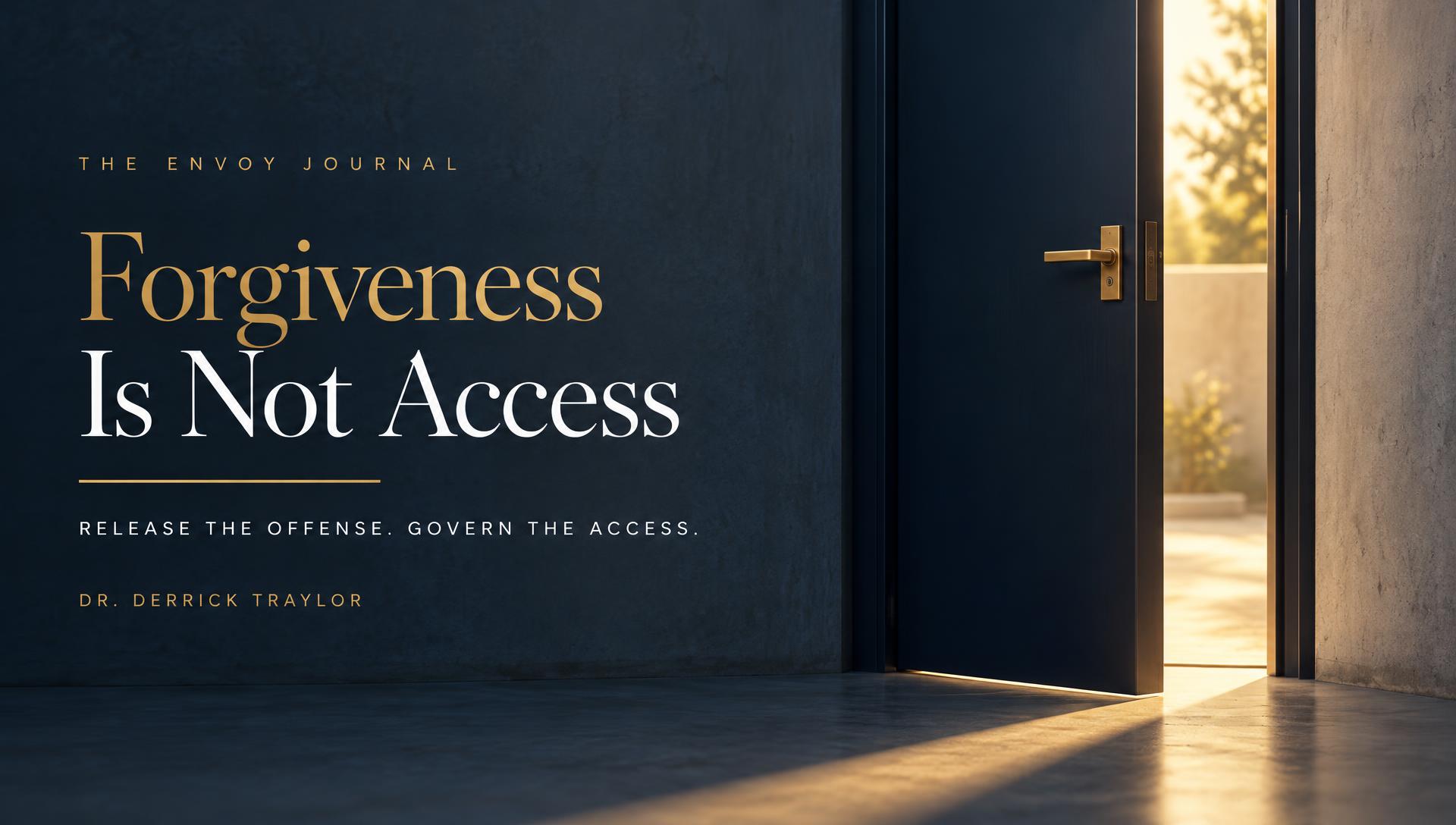
Forgiveness releases the offense. Boundaries govern future access. Learn the difference between forgiveness, restored trust, and reconciliation — and why you can be free without being foolish.
Some believers have carried an offense for five, ten, fifteen, even twenty years. They love God. They pray. They serve. They sound like the church and look like the church. And yet, in one area of their life, nothing seems to grow.
Often the reason is not a lack of anointing. It is a knot in the hose.
Picture water flowing through a garden hose. The supply is full, but somewhere along the line there is a knot. The water can only come so far before it backs up. Unforgiveness works the same way. God's flow is real, but it is being hindered by an unresolved offense.
Many people refuse to deal with that knot because of one fear: If I forgive them, I have to let them back in. That fear is built on a misunderstanding. Forgiveness does not mean giving someone access again.
“Forgiveness releases the offense. Boundaries govern future access.”
Guard the Gates: Why This Matters in Spiritual Warfare
This teaching belongs to our Rules of Engagement series under Guard the Gates. The fifth principle within that rule is simple and weighty: unforgiveness creates internal bondage.
Jesus connected forgiveness directly to prayer: "And when ye stand praying, forgive, if ye have ought against any: that your Father also which is in heaven may forgive you your trespasses" (Mark 11:25). He said it again in Matthew 6:14–15: if we do not forgive others, our Father will not forgive us.
That means unforgiveness is not a small personal issue. It is an open gate. An intercessor can be used of God in public and still be hindered in private, because God will never be a party to our unforgiveness.
How an Offense Becomes a Root
Unforgiveness rarely starts as hatred. It grows in stages:
- 01An offense that is held turns into unforgiveness.
- 02Unforgiveness that is held turns into bitterness.
- 03Bitterness becomes a root, harder and harder to pull up.
- 04That root is ready to produce hatred, and hatred brings forth death.
Hebrews 12:15 warns us to look diligently "lest any root of bitterness springing up trouble you, and thereby many be defiled." Ephesians 4:31–32 tells us to put away bitterness, wrath, anger, and malice, and to be kind, tenderhearted, forgiving one another, "even as God for Christ's sake hath forgiven you."
The longer an offense stays, the deeper it goes. Deal with it while it is still an offense, before it becomes a root.
Unforgiveness Keeps the Wound Talking
Unforgiveness keeps an offense emotionally alive. The event may be over. The person may be gone, even deceased. But the wound keeps speaking.
And when the wound keeps speaking, it starts to influence everything:
- your discernment
- your relationships and your trust
- your leadership
- your emotional regulation
- your prayers
- how you interpret situations
- your decision making
There is also a quieter cost. In the area where unforgiveness lives, your growth stops. You may be mature in many parts of your life, but in that one area, you are frozen in time — standing like a statue at the moment you were hurt. That is exactly what the enemy wants: to freeze you so you cannot see "the goodness of the LORD in the land of the living" (Psalm 27:13).
What Forgiveness Is Not
Before we can forgive freely, we have to clear away what forgiveness is not.
- Forgiveness does not mean what happened was acceptable. Wrong is still wrong. Forgiving does not call evil good.
- Forgiveness does not eliminate boundaries. You can release someone and still protect yourself.
- Forgiveness does not always restore the relationship. Sometimes the relationship ends, and forgiveness is still complete.
- Forgiveness does not let them off the hook. It lets you off the hook — and it frees God to deal with them. God will not deal with your offender while you are still busy dealing with them.
What Forgiveness Is
Here is the definition to hold on to:
“Forgiveness means I refuse to allow what happened to me to continue controlling what happens inside of me.”
That is freedom. You are not going to be controlled by someone who has moved on, someone who is broke, someone who is unstable, or someone who is no longer even alive. Nobody deserves that kind of power over your heart.
It helps to make a settled decision ahead of time: If you offend me, as a general rule, you are forgiven. Let offense roll off like water off a duck's back. Keep loving. Keep praising. Keep smiling. Keep moving.
And remember, forgiveness is not a work of the flesh. It is an empowerment of the Holy Spirit. You cannot manufacture it, but you can want it — and ask God for it.
Forgiveness, Restored Trust, and Reconciliation Are Three Different Things
Much of our confusion comes from treating three separate things as if they were one.
1. Forgiveness
Forgiveness is commanded and immediate in its intent. It happens between you and God. It does not require the other person to apologize, change, or even know. You release the debt and hand the case to the Righteous Judge.
2. Restored Trust
Trust is earned and rebuilt over time. Forgiveness can be given in a moment; trust is restored through consistent, changed behavior. You can fully forgive someone and still say, "I do not trust you yet." That is not bitterness. That is wisdom.
Jesus Himself modeled this. John 2:24–25 says He "did not commit himself unto them, because he knew all men." He loved people fully without handing everyone full access.
3. Reconciliation
Reconciliation is the restoring of the relationship, and it takes two. It requires honesty, repentance, and real change from the person who caused harm. Romans 12:18 says, "If it be possible, as much as lieth in you, live peaceably with all men." If it be possible — because sometimes it is not, and that is not your failure.
Put simply:
- Forgiveness deals with the past.
- Trust deals with the present.
- Reconciliation deals with the future of the relationship.
You owe the first. The other two depend on what is safe, wise, and true.
Boundaries Govern Future Access
Boundaries are not punishment. They are stewardship. Proverbs 4:23 says, "Keep thy heart with all diligence; for out of it are the issues of life."
It sounds like this:
I forgive you — but you can't come to my house. I forgive you — but I'm not going out to eat with you. I'm going to keep loving you, keep praying for you, keep smiling when I see you. But forgiveness does not mean I have to be foolish.
A healthy boundary might mean:
- limiting how much personal information you share
- keeping contact in public or structured settings
- declining to put someone back in a position of influence or leadership
- refusing to re-open conversations that only reopen wounds
- ending contact entirely where there has been abuse or danger
None of those cancel forgiveness. They simply recognize that access is a privilege, and privileges follow trust.
How to Begin Releasing an Offense
- 01Name it honestly. Tell God what happened and how it affected you. He can heal what you are willing to admit.
- 02Ask for empowerment. Pray, "Holy Spirit, give me the power to forgive." This is His work in you.
- 03Release the debt. Say it out loud: "I release them. I will no longer hold this against them."
- 04Hand over the case. Trust God to judge rightly (Romans 12:19).
- 05Set wise boundaries. Decide what access is appropriate now, without guilt.
- 06Repeat as needed. When the memory returns, release it again. Forgiveness is a decision you keep honoring.
Reflection Questions
- 01Is there an offense you have carried for years? What has it cost you?
- 02Where has unforgiveness affected your prayers, discernment, or decisions?
- 03Have you been avoiding forgiveness because you thought it meant letting someone back in?
- 04Who do you need to forgive, and what boundary do you also need to set?
- 05In what area of your life might you feel "frozen in time"?
A Prayer for the Power to Forgive
Father, in the name of Jesus, search my heart. Search my mind and the intents of my heart. Show me every offense I have held and every root of bitterness that has tried to grow. I confess that I cannot forgive in my own strength, so I ask You for the empowerment of Your Holy Spirit. I choose today to release those who have hurt me. I let them go into Your hands. Untie every knot in my life so that Your flow can move freely again. Give me wisdom to set healthy boundaries without bitterness, and grace to walk in healing, wholeness, and victory. Thank You for the power to forgive. In Jesus' name, Amen.
Declarations
- I will not sit in offense, unforgiveness, or bitterness.
- I have the character of God and the fruit of the Spirit.
- What happened to me will no longer control what happens inside of me.
- My momentum will not be stopped and my blessings will not be hindered.
- I forgive freely, and I guard my gates wisely.
- I will see the goodness of the Lord in the land of the living.
Final Word
Forgiveness sets you free. Boundaries keep you free. You can release the offense completely and still decide, prayerfully and wisely, who walks through your gate. That is not hardness. That is maturity.
Scriptures for Further Study
Mark 11:25–26 · Matthew 6:14–15 · Matthew 18:21–35 · Ephesians 4:26–27, 31–32 · Hebrews 12:15 · Proverbs 4:23 · Romans 12:17–21 · John 2:24–25 · Colossians 3:13 · Psalm 27:13
Called to stand in the gap?
Join the Kingdom Envoy Institute as an Associate Envoy and be formed in strategic Biblical intercession.